
An auditorium has to deliver clear speech to the back row and full-range music to every seat, often in the same event. Prowave auditorium systems combine line array speakers, subwoofers, amplifiers, mixers and microphones into one matched setup, so integrators can specify a complete hall from a single brand.
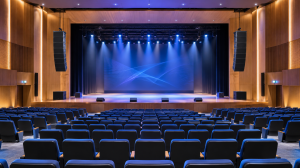
Where it fits
- Conference halls and convention centres
- University lecture theatres and school auditoriums
- Government and corporate assembly halls
- Cultural centres and multi-purpose halls
- Houses of worship
Common challenges and how to solve them
Uneven coverage from front to back
Challenge. In a deep hall, the front rows are too loud while the back rows struggle to hear. Side seats and balconies often fall outside the main speakers’ coverage.
Solution. Line arrays are aimed and splayed so level drops slowly with distance, keeping front and rear rows close in volume. Front-fill and delay speakers cover the seats the main arrays cannot reach.
Speech that is loud but not clear
Challenge. Hard walls and high ceilings create long reverberation. Words blur together, and turning up the volume only makes it worse.
Solution. Directional speakers put sound on the audience and keep it off walls and ceiling. DSP equalisation and delay alignment tighten the response, so intelligibility improves without extra level. In very reverberant rooms, acoustic treatment should be planned alongside the system.
Feedback from stage microphones
Challenge. Lectern and handheld microphones near loudspeakers start to howl before speech is loud enough.
Solution. Main speakers are placed in front of the microphone positions, and cardioid or supercardioid microphones reject sound from behind. Feedback suppression in the DSP adds further usable gain.
One hall, many event types
Challenge. The same hall hosts a lecture in the morning and a concert or graduation at night. Settings that suit speech rarely suit music.
Solution. Subwoofers extend the system for music and video, and can be switched off for speech. Saved scenes on the mixer or DSP let staff recall Speech, Music or Ceremony settings with one press.
Operated by non-technical staff
Challenge. Many auditoriums have no full-time sound engineer. Complex controls lead to wrong settings and frequent support calls.
Solution. A simplified control panel and locked presets limit what daily users can change. The integrator keeps full access for tuning and maintenance.
Mixed brands and unclear responsibility
Challenge. Speakers, amplifiers and mixers from different suppliers are harder to match, document and support.
Solution. Specifying the whole chain from one brand simplifies system matching, documentation and after-sales support. [PLACEHOLDER: Prowave warranty and technical support terms]
System components
| Component | Role in the system |
|---|---|
| Line array speakers | Main left/right coverage with even level from front to back |
| Subwoofers | Low-frequency extension for music and video playback |
| Front-fill and delay speakers | Cover front rows, under-balcony and rear seats the main arrays miss |
| Power amplifiers | Drive the speaker system with headroom for peaks |
| DSP / speaker processor | Equalisation, crossover, delay alignment and feedback control |
| Digital mixer | Mixes microphones and playback sources; stores scenes |
| Microphones | Lectern, wireless handheld and headset mics for presenters and performers |
Recommended models: [PLACEHOLDER: model names with links to product pages]
What we need to prepare a proposal
- Floor plan and section drawings, or room length, width and ceiling height
- Seating capacity and balcony layout
- Main uses: speech, live music, video playback, ceremonies
- Existing equipment to keep or replace
- Project location and target schedule
Get a system proposal
Send us your hall drawings and requirements. We will reply with a recommended Prowave system and the matching datasheets.